
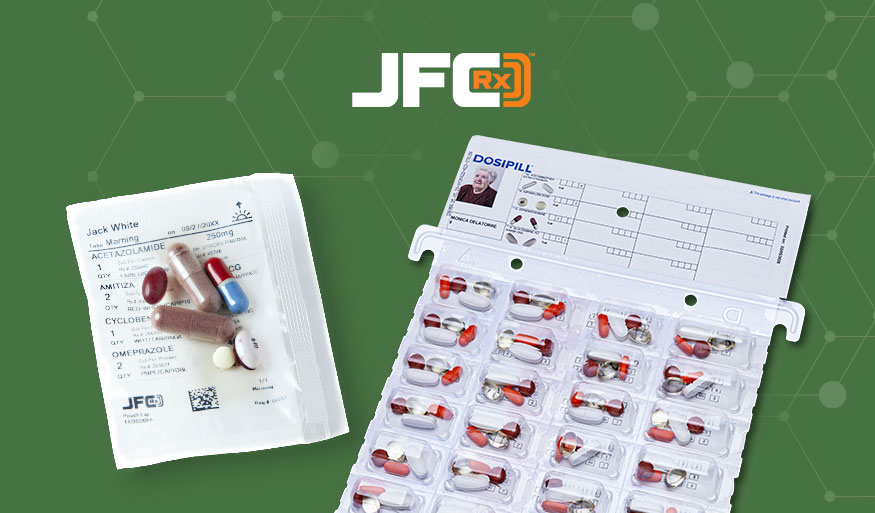
Pouch Or Card? How To Choose The Right Adherence Packaging Format For Your Pharmacy
It’s one of the most consequential decisions in automation — and for most pharmacies, the right answer isn’t either/or.
Decades of research, confirmed again as recently as 2025, consistently find that roughly half of patients prescribed long-term medications for chronic conditions don’t take them as directed.1 The consequences are not abstract: an estimated 125,000 Americans die preventably every year as a result, and the healthcare system absorbs hundreds of billions of dollars in costs that proper adherence could have avoided.2 Adherence packaging exists to close that gap, and modern automation has made it more accessible than ever. But as pharmacies invest in these programs, a pivotal question keeps surfacing: should we go with blister cards or strip pouches?
of chronic-condition patients don’t take medications as directed
WHO & Frontiers in Pharmacology, 2024
preventable deaths annually in the U.S. linked to medication non-adherence
PMC / American Family Physician
in avoidable healthcare costs each year
CDC MMWR
The answer, increasingly, is: it depends — and more often than not, it’s both. Here’s how forward-thinking pharmacy operators are thinking through the decision.
The case for blister cards: clinical visibility at a glance
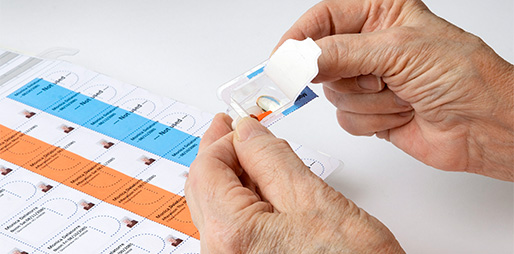
Blister cards have earned their longevity. In long-term care, behavioral health, and PACE settings, they do something pouches can’t quite replicate: they let a nurse, caregiver, or patient see an entire week’s worth of doses at once. A missing pill is immediately visible. The visual accountability for high-acuity patients managing a dozen medications across multiple daily windows isn’t a convenience, but a clinical safeguard.
Modern blister card automation, including JFCRx’s TruCard™ platform, takes that clinical value further. Color-coded cards organized by time of day, perforated individual-dose wells for portability, and medication images printed directly on the card combine to create packaging that supports not just adherence, but recognition. This distinction is especially important for patients with cognitive challenges or language barriers.
“For us, adherence cards are more than packaging. They are a clinical and adherence tool. They allow our board-certified geriatric pharmacists to place medications into the most appropriate administration times based on the full regimen — accounting for drug-drug interactions, pharmacokinetic considerations, timing of administration, and the overall therapeutic plan.”
Michael Greenhalgh, RPh · President, CareKinesis · Moorestown, NJ
In addition, for facilities with established med-pass routines built around weekly or monthly cards, there’s also the practical matter of workflow continuity. Blister cards require minimal retraining and integrate naturally into nursing home dispensing protocols. The supplies pharmacies with a real advantage during a period when staff shortages or the lack of qualified staff remains a prevalent industry issue2.
The case for strip pouches: throughput, personalization, and room to grow
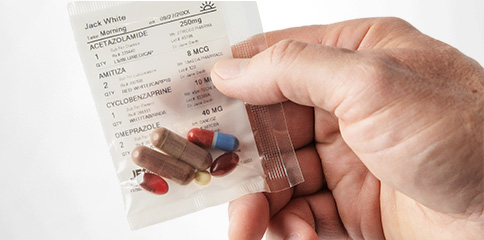
Strip pouch systems — like JFCRx’s TruPak™ — take a different architectural approach. Rather than organizing doses in a physical card layout, they produce a continuous, patient-specific roll of individually sealed pouches, each printed with the patient’s name, administration time, medication list, and a scannable barcode. For pharmacies scaling adherence programs, the operational math is compelling: higher throughput, fewer technician touchpoints, tighter EMR integration, and a significantly smaller storage footprint than an equivalent volume of blister cards.
Pouches also shine in community and home-care models where patients are largely self-managing. A pouch roll is intuitive — tear, open, take — and barcoding supports closed-loop verification in ways that manual card inspection simply can’t match. As LTC At Home programs expand and more complex patients age in place, that combination of simplicity and auditability is increasingly valuable.
“This is precisely why we chose to invest in the TruPak system. Our primary motivation is the anticipated growth in the Long-Term Care At Home sector. In many instances, a pouch system offers a more cost-effective solution for delivering care to LTC At Home patients while also addressing their needs efficiently. And with IRA and PBM reform reducing reimbursements, having that TruPak machine will help us maintain margin in an uncertain time.”
Jason Dana Costa · President & CEO, Horizon Pharmacy · Warwick, RI
When the answer is both: the case for dual-format automation
The pharmacies navigating this decision most successfully aren’t choosing a format but instead, choosing a strategy. Blister cards for LTC facilities, behavioral health, and complex polypharmacy patients where clinical oversight demands visual structure. Pouches for growing home-care populations, medication synchronization programs, and any patient who benefits from simplified, take-and-go packaging.
Jason Dana Costa at Horizon Pharmacy describes how this plays out in practice: behavioral health patients in acute phases benefit from the structure of blister cards, while patients in recovery — regaining cognitive function but still needing multi-dose packaging — often transition naturally to a pouch-based system.
The dual-format approach does require investment in both platforms. But for pharmacies with diverse patient populations and facility relationships, that flexibility is the point. It allows you to modernize operations, expand adherence program capacity, and meet partners where they are, without forcing a clinical trade-off that doesn’t actually serve your patients.
Starting from scratch? Here’s a framework
If you’re evaluating your first automation investment, consider your patient mix first. A community pharmacy with a growing chronic care population and home-delivery ambitions may find that pouch automation generates faster ROI at lower per-unit cost. A pharmacy heavily embedded in LTC and behavioral health settings, where facilities have strong preferences for card-based dispensing, may find that blister card automation is the natural foundation. Either way, building toward dual capability positions you for the next stage of growth, whatever direction your adherence program takes.
JFCRx supports both packaging modalities through its TruCard™ blister card platform and TruPak™ strip pouch system. To discuss which configuration fits your pharmacy’s current model and growth goals, contact a JFCRx specialist.
1 Kardas P, et al. “Medication non-adherence: reflecting on two decades since WHO adherence report.” Frontiers in Pharmacology, 2024. pmc.ncbi.nlm.nih.gov
2 Cutler RL, et al. “The unmet challenge of medication non-adherence.” PMC / American Family Physician. pmc.ncbi.nlm.nih.gov