
Solving The Crisis Of Medication Non-Adherence Starts In The Pharmacy
By JFCRx | In Partnership with Jones Healthcare Group | May 2026
Medication non-adherence is a global issue with significant impacts on health outcomes and the healthcare system at large.
Half of all Americans don’t take their medications as prescribed. Read that again. Despite a prescription being written, filled, and handed over, half the time, patients aren’t following through. Peer reviewed studies consistently show that medication mismanagement is significantly higher among adults age 65-plus, particularly with regard to timing, dosage, frequency, and duration. That gap between prescription and adherence has enormous consequences: for individual health, for the healthcare system, and for the pharmacists who work hard every day to serve their communities.

We’re proud to partner with Jones Healthcare Group — a global leader in medication packaging and adherence solutions with over a century of experience — to bring you this evidence-based look at medication adherence. Jones has given us permission to adapt their research and share it with you, and we encourage you to visit their website to learn more.
Jones Healthcare Group’s research paints a stark picture of medication adherence in the U.S. Consider these figures:
| 50% of patients don’t take meds as prescribed |
91% of adults 65+ take 1+ prescription drugs daily |
67% of seniors have 3+ drug prescriptions |
40% of seniors have 5+ drug prescriptions |
With the number of seniors in America age 65 and older set to double by 2060, and those living with chronic disease expected to reach a staggering 157 million, medication adherence will continue to play an increasingly important role in improving patient outcomes and reducing costs.
The downstream effects of patients not taking medications as prescribed are staggering. According to Jones Healthcare Group’s research, drug non-adherence is the true cause of:
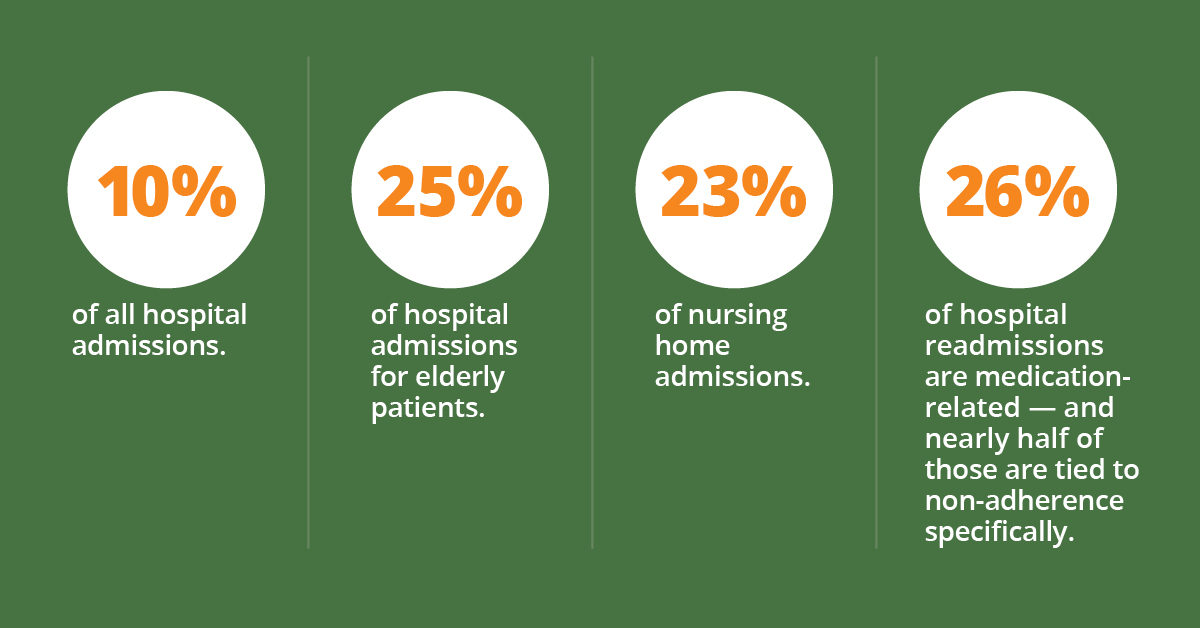
The financial picture is equally alarming. Non-optimized medication therapy results in an estimated $528.4 billion per year in preventable costs to the healthcare system globally.
For patients managing chronic conditions, adherence rates are especially poor. High cholesterol patients adhere to their medications only 57% of the time. For high blood pressure, it’s 48%. Diabetes: just 43%. These are life-altering, potentially life-threatening conditions, yet patients aren’t staying the course.
Why Is Medication Adherence So Difficult?
The complexity of a patient’s medication regimen is one of the biggest drivers of non-adherence. Research shows that adherence drops dramatically as dosing frequency increases. Patients who take a medication once a day adhere roughly 80% of the time. Patients taking the same medication four times a day? That drops to 50%.
For seniors, a population segment experiencing rapid expansion; the challenge is compounded. With 67% of seniors managing three or more prescription drugs and 40% juggling five or more, keeping track of what to take, when, and in what dose becomes genuinely difficult. The senior population is projected to double by 2060, meaning this challenge will only intensify.
The Pharmacist Is Still the Best Resource
Targeted interventions work. Research consistently shows that personalized pharmacist-to-patient engagement significantly improves adherence outcomes. Patients were more adherent to their medications — and refilled prescriptions faster — when their pharmacist was actively involved in their care.
Each year American pharmacies fill 4 billion prescriptions. That volume of interaction represents an enormous opportunity to identify at-risk patients, educate patients on proper medication use, and intervene before non-adherence leads to hospitalization.
Adherence packaging is one of the most effective tools pharmacists can deploy. Blister packs and calendarized multi-dose cards, like those developed by Jones Healthcare Group, help patients visually track whether they’ve taken their doses, reduce the risk of missed or double doses, and are far less likely to contain errors than pill boxes filled at home by patients or caregivers.
Cost is a Factor
Without universal coverage, out-of-pocket prescription costs create a significant additional barrier for American patients. Research shows that prescription abandonment rates are under 5% when there is no out-of-pocket cost — but that number climbs to 45% when a prescription costs more than $125 and reaches 60% when the cost exceeds $500. For many U.S. patients, non-adherence isn’t a matter of forgetfulness. It’s a financial decision made at the pharmacy counter. That makes the role of a trusted, proactive pharmacist even more critical — one who can identify lower-cost alternatives, navigate coverage options, and help patients stay on their medications without compromising their budget.
Let’s Keep the Conversation Going
At JFCRx, medication adherence isn’t just a talking point — it’s core to what we do. Whether you’re managing a complex medication regimen yourself, supporting an aging family member, or simply trying to make sense of a crowded pill organizer, we’re here to help.
Talk to JFCRx about adherence packaging options and personalized medication management support. Small changes in how medications are packaged and presented can make a meaningful difference in how consistently they get taken — and in long-term health outcomes.
And for more evidence-based reviews on medication adherence, we encourage you to visit the Jones Healthcare Medication Adherence page.
Source: This post was adapted with permission from Jones Healthcare Group’s evidence-based review, Spotlight on Medication Adherence: Calendarized Blister Packaging for Better Health Outcomes. Related statistics and citations are drawn from their original research.
For a complete study of how well-designed adherence supports — including pharmacist-led interventions and blister packaging — can help patients take their medications more safely, more consistently, and with greater confidence, visit Jones Healthcare’s newest reference guide.